
A large seizure makes headlines. But proving a trafficking case against a specific person takes a lot more than a photo of what customs agents found.
A large fentanyl seizure at the Arizona border generates immediate headlines. But for our criminal defense team, the discovery of drugs is really just the beginning of a much more detailed inquiry: who knew about the shipment, what evidence connects that person to it, and can the government actually prove its allegations beyond a reasonable doubt?
Those questions arise from a recent report involving a pickup truck entering the United States through Nogales. We review what’s publicly known, and walk through the legal issues our attorneys would examine if we were retained on a case like this one.
Facing a federal drug investigation in Arizona? Talk to a former federal prosecutor today by calling
What Authorities Reported About the Nogales Seizure
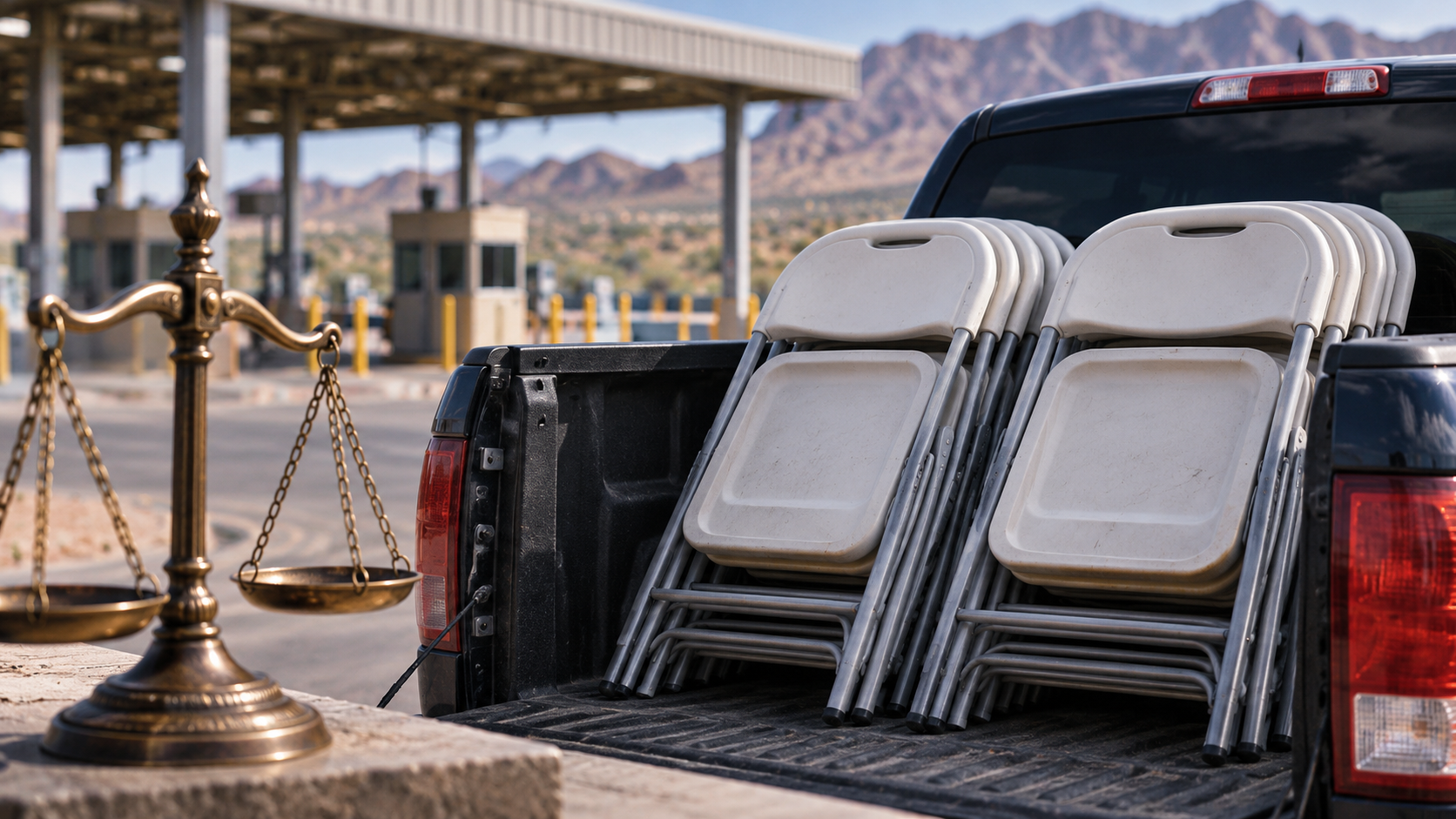
According to AZFamily, Customs and Border Protection officers discovered approximately 112 pounds of suspected fentanyl concealed inside folding chairs during a search at the DeConcini Crossing. CBP’s November 10 announcement said officers referred a 36-year-old U.S. citizen driving a 2006 Nissan Titan to secondary inspection on November 3, 2026, where inspection technology flagged irregularities in the plastic folding chairs. A canine then alerted to narcotics, and a physical search allegedly uncovered more than 300 packages of fentanyl hidden inside. CBP reported seizing the drugs and the vehicle, with Homeland Security Investigations taking over the case. (publicnow.com)
Authorities haven’t disclosed what happened to the driver afterward. That leaves an important distinction between a reported drug seizure and an established criminal case against a specific person — and it’s a distinction we never lose sight of when we’re evaluating a case like this one. A seizure is not an arrest, and an arrest is not a conviction.
Hidden Drugs Make Knowledge the Central Issue
When drugs are concealed inside ordinary cargo — here, folding chairs — the government has to answer a fundamental question: did the accused actually know they were transporting a prohibited drug? The Ninth Circuit’s model jury instruction for unlawful importation requires the government to prove, beyond a reasonable doubt, that the defendant knowingly brought a controlled substance into the United States and knew it was that substance or another prohibited drug. Prosecutors generally don’t have to prove the defendant knew the precise drug identity. (Ninth Circuit Model Jury Instructions)
That distinction can shape an entire defense. Someone who knowingly transports illegal drugs generally can’t defeat an importation charge merely by arguing they thought the shipment held a different prohibited substance. But a person who genuinely didn’t know any drugs were present raises a very different issue — whether the required knowledge existed at all. In a concealed-cargo case, our attorneys look closely at who purchased, owned, or supplied the cargo; who loaded it into the vehicle; how long the driver possessed the vehicle and its contents; whether other people could access the shipment before the crossing; whether any modifications were visible during ordinary handling; and whether the driver’s statements match independently verifiable records. These are investigative questions, not claims about what occurred at Nogales — the public reporting doesn’t answer them.
Prosecutors may argue that the shipment’s size, preparation, or value supports an inference of knowing participation. We may examine, in turn, whether the concealment prevented someone handling the cargo from ever recognizing its contents. Neither argument resolves a case by itself; its strength depends on the complete evidence.
Deliberate Ignorance (Willful Blindness)
In some cases, prosecutors pursue a deliberate-ignorance theory instead of proving direct knowledge. Under the Ninth Circuit’s model instruction, this requires more than showing a person should have been suspicious — the jury must find, beyond a reasonable doubt, that the defendant recognized a high probability of the relevant fact and deliberately avoided learning the truth. Mere negligence, carelessness, or foolishness doesn’t satisfy that standard. (Ninth Circuit Model Instructions, 2026) We examine whether the government actually has evidence of deliberate avoidance, or is simply asking jurors to equate an imprudent decision with intentional participation.
What Federal Charges Could a Border Drug Investigation Involve?
A drug seizure at an international crossing can lead investigators to consider several federal offenses. Which charges, if any, are actually filed has to be determined from the court record — but here’s what we’d be watching for:
- Unlawful importation. Federal law criminalizes knowingly or intentionally importing controlled substances contrary to the applicable importation provisions, generally charged under 21 U.S.C. § 952 and 960. We examine the evidence of importation and the evidence of knowledge separately — proof that a substance crossed the border doesn’t dispense with proof of the defendant’s required mental state.
- Possession with intent to distribute. Prosecutors may also consider possession with intent to distribute under 21 U.S.C. § 841, which addresses knowing or intentional possession paired with the required distribution intent. We’d investigate the accused person’s control over the contraband, their knowledge of its presence, and the evidence offered to establish intent.
- Attempt or conspiracy. Federal law also provides penalties for attempting or conspiring to commit controlled-substance importation offenses under 21 U.S.C. § 963, which carries the same penalties as the underlying offense. If investigators pursue a broader case, communications and relationships may draw close scrutiny — we’d investigate the full context of what participants actually discussed, what each person understood, and whether the evidence truly supports an alleged agreement. Nothing in the seizure announcement alone establishes a particular person’s role in a larger organization.
Why the Reported Fentanyl Weight Requires Careful Examination
The reported quantity attracts attention because federal drug penalties can depend heavily on substance type and weight. For a qualifying fentanyl importation offense involving at least 400 grams of a mixture or substance containing a detectable amount of fentanyl, 21 U.S.C. § 960(b)(1)(F) generally provides a prison range of 10 years to life, before any applicable enhancements or statutory relief. That threshold concerns the qualifying mixture or substance — it doesn’t require 400 grams of pure fentanyl.
A news report’s weight figure is never a substitute for the underlying evidence. We’d want to review the laboratory identification of the seized substances, the net drug weight after excluding packaging, the sampling methods used across the reported 300-plus packages, the evidence tracking and chain-of-custody records, and any differences between preliminary field results and final laboratory findings. Where a quantity increases the statutory minimum or maximum punishment, it generally has to be charged and proved beyond a reasonable doubt, unless admitted through a plea. (U.S. Sentencing Commission) A discrepancy matters according to its effect on substance identification, the quantity attributable to the defendant, or the applicable penalty — not simply because two records use different numbers.
Border Searches Follow Different Fourth Amendment Rules
A realistic defense analysis has to account for the government’s broad authority at an international border. In United States v. Flores-Montano, the Supreme Court held that border officials didn’t need reasonable suspicion to remove, disassemble, and reassemble a vehicle’s fuel tank during the search at issue. Routine border inspections generally don’t require the warrant or probable cause that might be necessary in other settings.
So the absence of a warrant doesn’t by itself establish that a border cargo search was unlawful, and a dispute about a canine alert may not invalidate a search that’s independently authorized by border-search law. Still, we reconstruct the encounter carefully — the location, timing, methods used, detention, and any questioning may present different legal issues of their own. A sound motion has to connect the challenged conduct to the rule that actually governs it, rather than assuming every drug search can be contested on the same grounds.
Early legal guidance can protect your rights before charges are even filed. Get your free case review.
What Our Defense Team Would Investigate First
The most useful defense work often begins with reconstructing the trip and preserving records before they disappear.
The Vehicle and Cargo Timeline
We’d seek a documented account of who possessed the truck, who handled the chairs, and when each transfer occurred — receipts, surveillance footage, witness accounts, travel records, and messages can all help test that timeline. An explanation becomes far more useful when independent evidence actually supports it.
The Complete Inspection Record
We’d request the available inspection images, photographs, reports, recordings, and evidence logs. Those materials can help establish what officers actually observed, how the search developed, and whether later descriptions accurately reflect the contemporaneous record — including how accessible or apparent the alleged concealment really was.
Statements and Their Context
Investigators often place substantial weight on a driver’s explanation of the trip. We examine any available recording, the exact questions asked, language or interpretation issues, and the circumstances surrounding the answers. A report’s summary of an interview can leave out context that changes its meaning entirely, which is why reviewing the original recording matters.
Digital and Financial Evidence
Messages, payment records, and location information may support or undermine an allegation of knowing participation. We review the surrounding conversations and alternative explanations, because a payment’s significance depends on its purpose and a message’s significance depends on what it actually communicates — not on how it looks in isolation.
Does a Large Seizure Automatically Mean a Life Sentence?
A statutory maximum of life imprisonment doesn’t predict the sentence in an individual case. Sentencing depends on the actual conviction, the legally established drug quantity, applicable sentencing rules, criminal history, and the person’s own conduct and role — federal law directs courts to weigh the offense’s circumstances alongside the defendant’s history and characteristics under 18 U.S.C. § 3553.
A mandatory minimum presents an additional constraint, and personal mitigation alone doesn’t let a judge disregard it. But certain defendants may qualify for statutory safety-valve relief under 18 U.S.C. § 3553(f), which permits sentencing without regard to an otherwise applicable minimum when every requirement is satisfied — eligibility requires an individualized review, and being a first-time defendant doesn’t automatically resolve it. We assess both trial issues and sentencing exposure early in every case, because disputes about quantity, role, statutory relief, or other sentencing facts can remain consequential even where the evidence supports a conviction.
Facing a Federal Drug Investigation in Arizona? Know Your Rights
A person connected to a border drug investigation may face urgent decisions before the full evidence ever becomes available. Early defense work focuses on preserving communications and receipts, identifying witnesses, obtaining the actual charging documents, and evaluating the evidence before anyone makes consequential decisions about interviews or how to resolve the case. For family members, one of the most useful first steps is simply getting accurate information about the person’s custody status and whether a case has actually been filed — public headlines rarely explain the charges, the procedural posture, or the available options.
The reported discovery at Nogales deserves serious investigation, and it illustrates why every criminal case has to be assessed person by person. The prosecution has to connect its evidence to the elements of an actual charge, and our attorneys test that connection through records, witnesses, scientific evidence, and the governing law. A reported quantity can’t replace proof of knowledge, and the seriousness of fentanyl allegations can’t lower the government’s burden.
Founding attorney RJ Suzuki is a former Deputy Maricopa County Attorney and Assistant United States Attorney, and that background on both sides of federal drug prosecutions shapes how we evaluate cases like this one — from the search at the border to the sentencing exposure years later. If you or a family member is connected to a federal drug importation or trafficking investigation in Arizona, contact us for a free consultation. We’re available 24/7, and the sooner we’re involved, the more we can do to protect your rights.
Under federal investigation? Don’t wait to protect your rights. Call .
You can learn more about our approach to these cases on our Phoenix Federal Crimes and federal drug crimes pages, or read more about drug trafficking defense generally. You can also meet our attorneys or read what past clients say.
This blog post is for informational purposes only and does not constitute legal advice. It reflects publicly available information reviewed as of November 11, 2026. The potential charges and defenses discussed here are general legal analysis, not an assertion that charges have been filed against the driver in this incident, and outcomes in any case depend on its specific facts.